

The refreshed UK Magenta Book is a real step forward for value-for-money (VfM) evaluation guidance, moving away from any implication that VfM can be settled by economic metrics alone, towards a balanced, evidence-informed judgement about good use of public resources. This includes not only monetary measures of outcomes but also distributional effects and outcomes that can’t credibly be monetised. Its explicit inclusion of the Four Es and rubric-based approaches is particularly important, because it legitimises structured evaluative synthesis and judgement where a single summary metric would be incomplete or misleading.
That is welcome news for those of us who’ve been arguing for more holistic and transparent VfM assessments. Although the Magenta Book was written for the UK context, it is influential internationally, distilling principles that are widely relevant wherever public, philanthropic, or social investments are evaluated. A previous post unpacked how the Value for Investment (VfI) approach can help put these principles and tools into practice.
I’m supportive of the new Magenta Book and how it expands the ways we can look at VfM. But things can always be improved, and this blog will keep pushing for better VfM assessment. In that spirit, I’m taking a critical look at one small but catchy element: the way the Four Es are presented as “spending less, spending well, spending wisely, spending fairly”. I’d like to offer a different take.
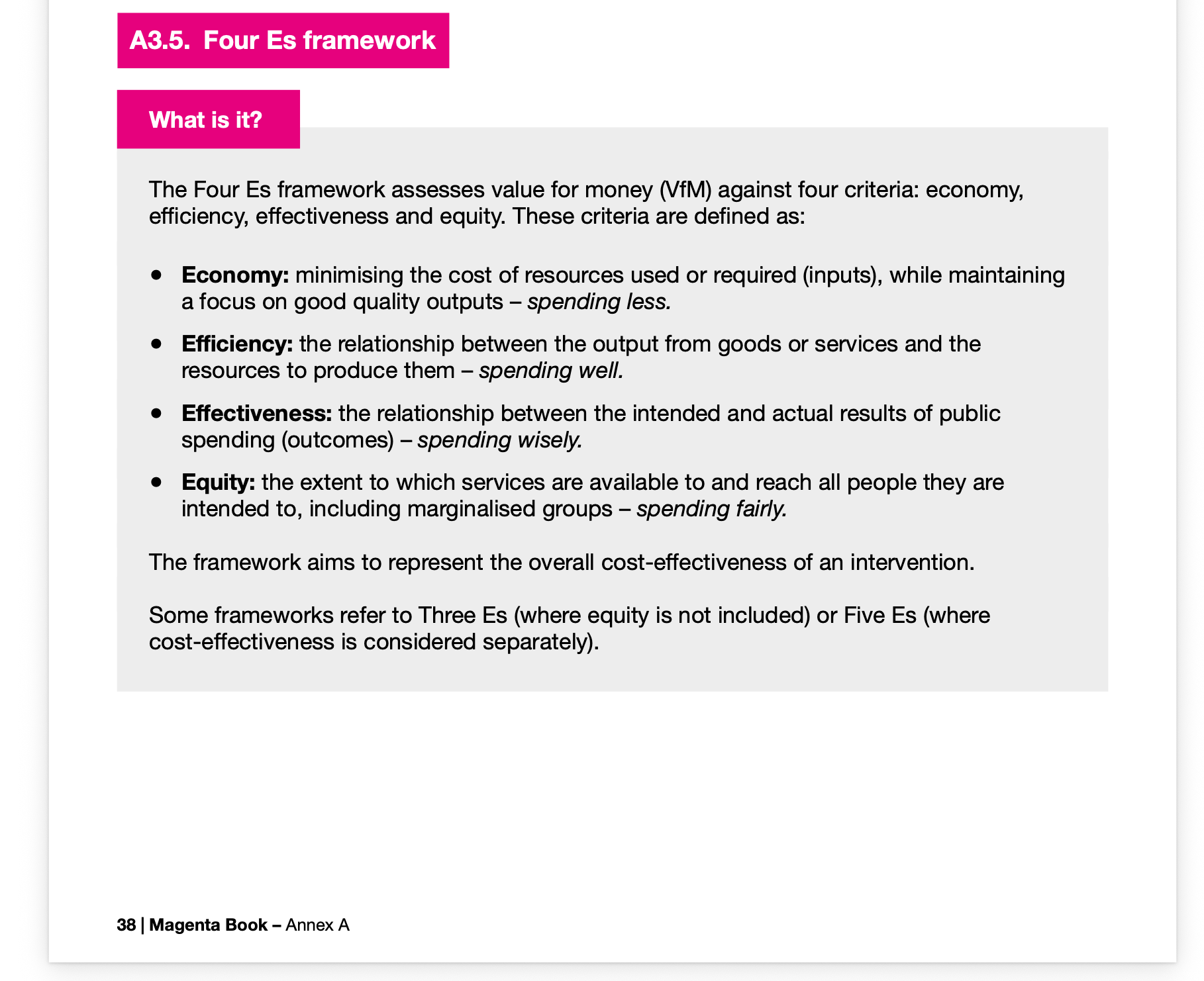
Four spending slogans
Annex A of the Magenta Book outlines the Four Es framework as a way of assessing VfM against four criteria: economy, efficiency, effectiveness, and equity. The annex gives fairly standard definitions of each E, along with a shorthand that associates:
Economy with “spending less”
Efficiency with “spending well”
Effectiveness with “spending wisely”
Equity with “spending fairly”.
These familiar spending slogans aren’t new coinages, but a simple way of talking about public spending that has circulated in audit and VfM circles for years. The framing is memorable, and could be tempting for busy practitioners to adopt as a set of simple “rules”. But that would be risky. If “spending less” is treated as the headline objective for economy, we can undermine VfM before we even begin.
Why “spending less” is a risky compass
In many VfM frameworks, economy is defined in terms of controlling the cost of buying the right inputs of the right quality, and the shorthand of “spending less” is a distilled version of that idea. There is a kernel of truth in it, of course. If we can keep costs under control for the inputs we need, there is more left over to spend on other things. All else equal, that can support good VfM.
But all else is seldom equal. Anyone who has tried to buy decent cookware, a child’s car seat, building materials, or a government-funded school lunches programme, knows that paying the lowest possible price is not the same as making the best use of resources for long-term value.
Cost control is important, but it is just one piece of a balancing act. Sometimes, spending more is what allows us to get a disproportionate gain in value, through better quality, durability, fitness for purpose and impact. In VfM assessment, our job is to understand value, not just minimise costs. If “spending less” is taken literally, uncritically, and becomes the target, it can encourage cost-cutting that undermines real value.
Economy, in the real world, is not about taking the razor to every line item. It is about resource stewardship: securing the right inputs, of the right quality, at the right time and price, to enable efficient delivery, effective and equitable impacts, and worthwhile value creation. That includes looking after non-financial resources (relationships, trust, knowledge, natural resources, staff wellbeing) as well as keeping a steady hand on the control of financial resources.
In that sense, “spending less” is a thin and distracting tagline for what we actually need to achieve.
Efficiency and effectiveness: much more than “spending well” and “spending wisely”
The slogans for efficiency and effectiveness are similarly distracting.
Efficiency has many meanings in different contexts, but in the 4Es framework, it focuses on how productively a set of organisational actions (within a policy, programme, service, pilot, etc) are carried out. In VfM practice, this has often been reduced to the idea of maximising outputs from a given level of inputs - a ratio that might make sense for a factory production line but is unhelpfully narrow for a complex investment in social change or system transformation.
“Spending well” has a nice ring to it, but it doesn’t align conceptually with efficiency and could apply equally to any other E without ever quite meaning anything. It is more useful to define efficiency along the lines of “productivity and ways of working” and to look at it from as many angles as necessary - e.g., taking the right actions, doing quality work, learning and improving, investing in working relationships, acting ethically - any aspect of programme design, content and delivery that make a critical difference between getting a lot of value or only a little.
Effectiveness, meanwhile, is about outcomes and impacts, the real changes in people, places and systems that can reasonably be credited to the intervention. It requires us to understand what changed, for whom, and why, and to judge how good those changes are. It requires reasonable attempts at causal inference and not assuming whatever happened can be attributed to the programme. “Spending wisely” doesn’t even gesture at this, let alone define the essence of effectiveness.
Equity: “spending fairly” is only the beginning
For a long time, there were just three Es - economy, efficiency, and effectiveness. The addition of Equity to the framework was a substantial leap forward because it gets to the heart of why many public policies and social programmes exist in the first place, and because it makes explicit that VfM involves trade-offs; you can’t maximise every criterion at once. For example, if your purpose is to reduce inequities, sometimes you have to spend more to make a worthwhile difference.
Equity, in the Magenta Book’s framing, highlights the importance of services being available to, and reaching, all people they are intended to, including marginalised groups – summarised as “spending fairly”. Of the four spending slogans, I find this the hardest to disagree with. But I still think we can do better.
In real programmes, equity is often about reducing existing inequities, and distributing resources, actions, impacts and value fairly. This includes, but is not limited to, “spending fairly”. For example, to achieve real equity gains, programme architects may also need to consider:
Equity in power – programme design, governance, delivery, monitoring, and evaluation conducted with or by communities, not done for or to them.
Equity of design – explicitly identifying inequities and groups intended to benefit, and co-designing approaches that fit culturally and practically.
Equity of resourcing – allocating enough resources to do meaningful work on inequities, and learning what level of resourcing is actually needed.
Equity of access, delivery, outcomes and impacts – ensuring programmes are accessible and acceptable, and that they reduce gaps between groups rather than widening them.
It is entirely possible to “spend fairly” in a narrow sense – to allocate budgets evenly or to meet headline access targets – while making little or no dent in underlying inequities, or even exacerbating them if power, culture and distribution of impacts are not taken seriously.
If we equate the 4Es with the four taglines of spending less, spending well, spending wisely and spending fairly, we risk perceiving everything as a financial control decision, diminishing the essential thinking behind each E, and missing the rich complexity of delivery, change, and value that are necessary to achieving and assessing good value for money. Financial control still matters, of course - but it is only part of what we mean by VfM. Ultimately, VfM is about using resources well to create things that matter to people.
Where’s the 5th E?
The Magenta Book annex states that the 4Es framework “aims to represent the overall cost-effectiveness of an intervention”, and this is another place where I recommend a different framing.
Cost-effectiveness is about whether an investment creates enough value to justify the resources invested in it. Something can be economical, efficient, effective, and equitable, and still fall short of the cost-effectiveness bar if, overall, the value created is not strong enough compared with what could have been achieved differently with the same resources.
Rather than treating cost-effectiveness as ‘the 4Es together’, it is more coherent to treat it as a 5th criterion in the 5Es framework and to assess it alongside the other Es - a practice that the Magenta Book does also acknowledge.
Reframing the Es from spending to value
So, if the slogans risk misdirection, what might a more helpful framing look like – one that remains compatible with the Magenta Book guidance but puts value rather than spending at the centre?
In my work, criteria are defined contextually and, if defining VfM in terms of the E-words, I tend to start from the following basic definitions and tailor them to the specific context.
Economy: Stewardship of monetary and non-monetary resources to support long-term value.
Efficiency: Productive ways of working that support long-term value.
Effectiveness: Changes in people, places, and systems that can reasonably be credited to the actions.
Equity: Reducing inequities and ensuring power, resources, actions, impacts and value are distributed fairly.
Cost‑effectiveness: Creating enough value to justify the resources used.
This reframing still aligns with the direction of the updated Magenta Book, which defines VfM as a judgement about good use of public resources and accommodates qualitative, quantitative, and economic methods in VfM assessment. Where my framing differs is in broadening and moving the focus from “spending” to value, moving us closer to the real aims of VfM in the public interest.
Practical steps for using the Es well
If you are working within Magenta Book guidance and want to avoid the pitfalls of the four “spending” slogans, there are some practical moves you can make.
First, ignore the slogans, and define programme‑specific VfM criteria. In principle, the 5Es are conversation starters rather than a complete framework. Your criteria could depart substantially, like the ones we used here. Or they could align with the 5Es but be expressed in language and sub-criteria that directly relate to your programme’s context and value proposition. Some recent VfM assessments have included a 6th E for Environment.
Second, recognise money as one resource among others in your economy criterion. Ask “What resources are invested and by whom?” and “What does good stewardship look like here?”. This opens the door to considering wider resource implications like environmental footprints, staff wellbeing, and how well political and social capital are invested, all of which matter to long-term VfM alongside financial controls, procurement practice and prices.
Third, make equity visible at every level of your VfM framework. Rather than treating equity as the last E, consider how inequities can be reduced through resource stewardship, ways of working, and outcomes, and incorporate those considerations across the whole framework.
Finally, don’t stop at criteria. Add standards - performance levels that describe what “good enough” looks like, as well as higher and lower levels. Starting with a clear set of criteria and standards (often set out in rubrics) allows you to combine mixed-methods evidence and make explicit judgements about how good performance is on each criterion.
While the Magenta Book presents rubrics, 4Es, and economic methods of evaluation separately as potential VfM approaches, it does acknowledge that they are not mutually exclusive and can be combined. My argument goes a little further, arguing they often should be combined to address evaluative questions about resource use and value creation. The Value for Investment approach provides a practical system for bringing them together.
An ongoing conversation about value
The 2026 Magenta Book represents a substantial shift in how the UK government thinks about evaluation and value for money. It moves us away from a view where a single benefit‑cost ratio tries to represent all value, and towards a richer, more grounded conversation about how public resources create value in complex systems.
The 4/5Es play a useful part in that conversation, systematically organising thinking about different parts of a simplified value chain. I do not see them as the final word on VfM assessment - other considerations like relevance, affordability, acceptability and sustainability are often just as important - but they are good prompts for developing VfM frameworks. My argument here is that we should deepen the E-words and resist turning them into slogans that substitute for judgement. Let’s retire the rhetorically neat but conceptually loose “spending less/well/wisely/fairly” and focus on the actual value proposition of the policy or programme we’re evaluating, and the criteria and standards that make that proposition evaluable.
If we can keep value, stewardship and equity at the centre of our VfM frameworks, then the Magenta Book will be easier to implement in spirit as well as in letter. And, crucially, we will be better equipped to answer the big VfM questions: How well are we using resources? Are we creating enough value? How can we create more value from the resources invested?
Free resource
If you’d like a practical guide to aligning the 5Es with your programme’s value proposition, you can download the free PDF, Value for Money and the 5Es: Designing a context‑specific VfM framework, from my website. It complements the Magenta Book by showing how the generic 5Es can be translated into criteria for your programme.
Book coming
The Value for Investment book is in production. Click here for a walk-through.
“Julian brings together an economist’s respect for scarce resources, an evaluator’s obsession with weaving a story that includes all the things that matter, and a decision maker’s impatience with academic waffle that doesn’t get to the point. The result is a book that is both conceptually solid and immediately usable.” - E. Jane Davidson
Thanks for reading!
And thanks to Daniel Wate for helpful review of an earlier draft. I take sole responsibility for the opinions expressed here and for any errors or omissions.
Dear Julian, the blog makes a useful case against reducing value for money to the simplistic idea of “spending less”. But it could go further by challenging the assumption that the Es - economy, efficiency, effectiveness and equity - can usefully be assessed as largely separate dimensions.
As I see it, the problem is that these are not independent characteristics of an intervention. They are interconnected parts of a single process of resource use and value creation. This is where Robert Kaplan’s work on activity-based costing is particularly relevant. Kaplan showed that costs cannot be understood simply by looking at input prices: we need to understand which activities consume resources, what drives those activities, and what they produce.
The same applies to VfM. A cheaper input may be less “economic” if it produces poorer-quality activities, higher downstream costs or weaker outcomes. Conversely, spending more may represent better resource stewardship if it substantially improves quality, durability or impact.
The Es should therefore not be treated as five boxes to tick. Economy affects efficiency; efficiency affects effectiveness; and decisions across all three affect equity. The more useful question is: how well are resources converted into valuable outcomes, for whom, at what cost and how?
That is a much stronger foundation for judging VfM than “spending less/shopping cheap, spending well, spending wisely and spending fairly”.