

By a stroke of good luck, one of my presentations at the 2022 European Evaluation Society Conference was in the same session as Bianca Montrosse-Moorhead, who gave an engaging presentation on her work with Daniela Schröter and Lyssa Becho on the Garden of Evaluation Approaches - a metaphor and organising framework for the diversity of evaluation approaches.
More recently, the Garden framework was published in the American Journal of Evaluation. I recommend reading it:
Montrosse-Moorhead, B., Schröter, D., & Becho, L. W. (2024). The Garden of Evaluation Approaches. American Journal of Evaluation. https://doi.org/10.1177/10982140231216667
What is the Garden of Evaluation Approaches?
The Garden is a practitioner-oriented classification of evaluation approaches, situating each approach in terms of eight dimensions of practice which are arranged visually as petals of a flower, together with additional symbology covering philosophical and methodological orientations. “This allows for approach comparison, a more nuanced understanding of where they overlap and differ, and how and where they can be intentionally combined” (p. 1).
The eight dimensions or ‘petals’ of the evaluation approaches in this metaphorical garden represent the extent to which the guidance for an evaluation approach includes (pp. 7-9):
Values: The surfacing and use of values (e.g., beliefs, attitudes, and ideas about what is valuable, good, important, or preferred)
Valuing: An implicit or explicit process of determining the merit, worth, or significance of something.
Activism for social justice: Taking clear action in support of social justice causes, positioning advocacy or activism as the primary purpose of evaluation activities.
Context: Directly and actively attending to the surrounding cultural, historical, and/or political contexts or systems.
Promoting use: Directly and actively facilitating use of evaluation findings, or of knowledge gained through the process of engaging in an evaluation.
Engagement in the evaluation process: Explicit consideration of who is involved in evaluation planning, interpretation, reporting, and decision-making.
Depth of engagement in the evaluation process: Explicit consideration of the extent to which different groups are involved throughout an evaluation and in what capacities.
Power dynamics in making evaluation decisions: Explicit consideration of how stakeholders are engaged in decision-making and how power is distributed among stakeholders.
The authors provide a rubric (yasss!) to facilitate classification, by probative inference, to the set of descriptions providing the closest fit for any given evaluation approach. For example, the Values dimension has four options as follows:
Unknown/missing.
Values have no role in the evaluation. The approach argues that evaluators minimise the influence of values.
Values are important, but the evaluation approach doesn’t play an active role in surfacing those values.
Values are central, and the evaluation approach plays an active role in surfacing and using them to guide the evaluation.
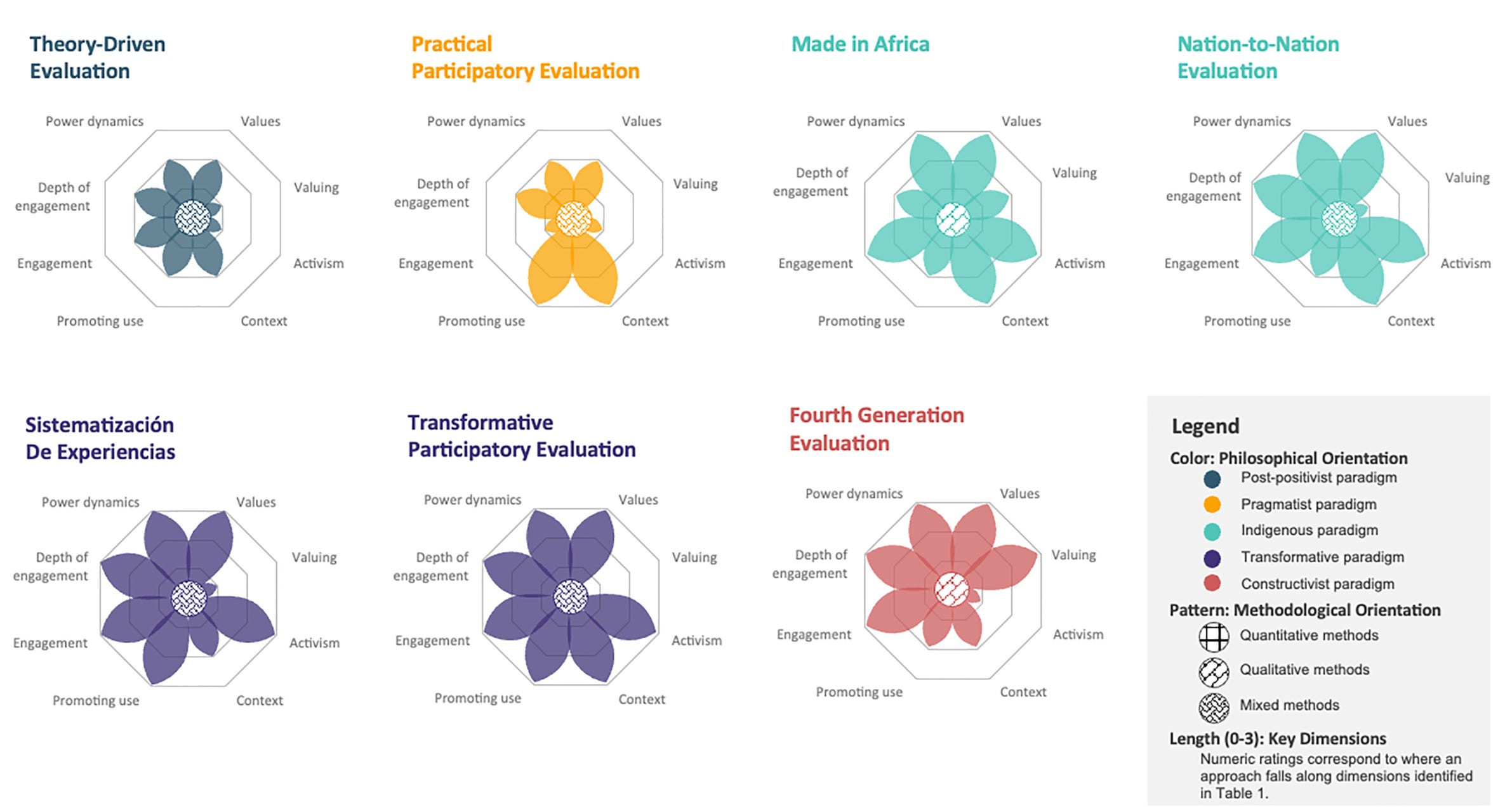
Using the rubric, the authors categorise seven evaluation approaches to illustrate how the garden of evaluation approaches works. The size of each petal reflects their assessment of each dimension, with the largest petals representing dimensions categorised at level 3 of their respective standards, the smallest petals representing level 1, and missing petals representing level zero (unknown/missing). Philosophical and methodological orientations are represented by the colour and pattern of the centre of the flower (see Legend):
Utility of the Garden
This framework could turn out to be quite useful. For example, it:
Provides a systematic way to understand and compare different evaluation approaches based on key dimensions, helping evaluators to select the most appropriate approaches for their specific needs and context.
Facilitates systematic comparison between approaches, highlighting the rich diversity of different approaches available, which may encourage evaluators to explore approaches beyond the mainstream.
Offers an intuitive visual way to consider the unique qualities and potential fit of different approaches, guiding evaluators in aligning their approach to the priorities of the evaluation.
Highlights aspects like social justice and stakeholder involvement, prompting evaluators to think beyond methods and critically examine issues of equity, inclusion and power in their practice.
Why I like it
It’s a nice metaphor! Aesthetically pleasing, engaging, and an accessible way to conceptualise evaluation approaches. I think it’ll help evaluators to understand, navigate and communicate the diversity of approaches within the field.
I like it more than the evaluation theory tree, and not only for the self-serving reason that I find it hard to place Value for Investment (VfI) on the tree (I guess it’s a twig on the valuing bough, but it intersects with every branch). More importantly, I prefer the Garden because it recognises the richness and plurality of evaluation orientations, placing all approaches on an equal footing without ceding primacy to (mostly) North American, old white dudes.
I like it as much as the braided rivers metaphor for the meeting and blending of knowledge systems. I find braided rivers helpful for contemplating the historical development of multiple ideas that coalesce to form part of the DNA of contemporary evaluation approaches. The Garden, in contrast, is helpful for thinking about what kinds of evaluation approaches there are and how they’re similar or different.
Where does Value for Investment sit in this Garden?
In a sunny patch, protected under the shade of a tree planted in memory of Michael Scriven, and cross-pollinated with multiple flowers from the garden (plus a few weeds over the fence), we find the Value for Investment (VfI) approach. It’s in flower and growing rapidly but yet to reach its full size. What does VfI have in common with other varietals and what differentiates it from the other flowers in the garden?
Using the rubric in the Garden of Evaluation Approaches article, together with VfI guiding principles espoused in this Substack series, in this guide and this guide, I characterise VfI as follows:
Values: 3. The VfI approach is underpinned by a process of evaluative reasoning in which values are central. The approach calls for an active role in surfacing and using the values of stakeholders and rights-holders to guide evaluation co-design and sense-making.
Valuing: 3. The VfI approach includes an explicit process for determining the merit, worth or significance of resource use. The steps in the process implement the general logic of evaluation: developing criteria and standards aligned with a program’s value proposition; collecting evidence; and synthesising the criteria, standards and evidence to make evaluative judgements. The guidance emphasises stakeholder collaboration as an integral part of the valuing process.
Activism for social justice: 0. The VfI approach is intended to guide evaluators in combining multiple values and kinds of evidence, in order to help people make warranted evaluative judgements. It neither prescribes nor proscribes what values should be included, rather it positions evaluation as inclusive and impartial.
Context: 3. Every stage of a VfI evaluation should be responsive to context. The VfI process includes explicit steps for understanding the context, developing contextual criteria and standards, selecting a mix of methods appropriate to the context, making contextualised evaluative judgements, and reporting in contextually appropriate ways.
Promoting use: 3. VfI evaluations are intended to be useful and to actually get used. The approach involves stakeholders and rights-holders in co-design, fact-finding, sense-making and reporting with explicit objectives of promoting validity, credibility, understanding, ownership, and use.
Engagement in the evaluation process: 3. VfI encourages the involvement of multiple groups in decision-making, drawing on Jane Davidson’s advice to canvass issues of validity, credibility, utility, voice (which includes holding the space for the voices of those who have historically been under-represented in evaluation), and cost when considering who needs to be ‘at the table’ - including, for example, those with formal power, program implementers, intended users, program recipients, participants, community members, and/or partner organisations.
Depth of engagement in the evaluation process: 2.5. VfI explicitly encourages more than just consulting those involved, framing evaluation design and implementation as a “collaborative, social practice” (after Schwandt, 2018). Therefore, it involves more than the depth of engagement described at level 2 of the Garden framework. However, it is neutral about involving stakeholders as partners, co-directors or directors so it’s below level 3.
Power dynamics in making evaluation decisions: 2.5. VfI calls for participatory, inclusive decision-making involving a broad range of engaged groups. However, from a pragmatic standpoint it gives evaluators the final say in facilitating, mediating or arbitrating decisions and judgements. Therefore it doesn’t fully conform to level 3 on the Garden framework.
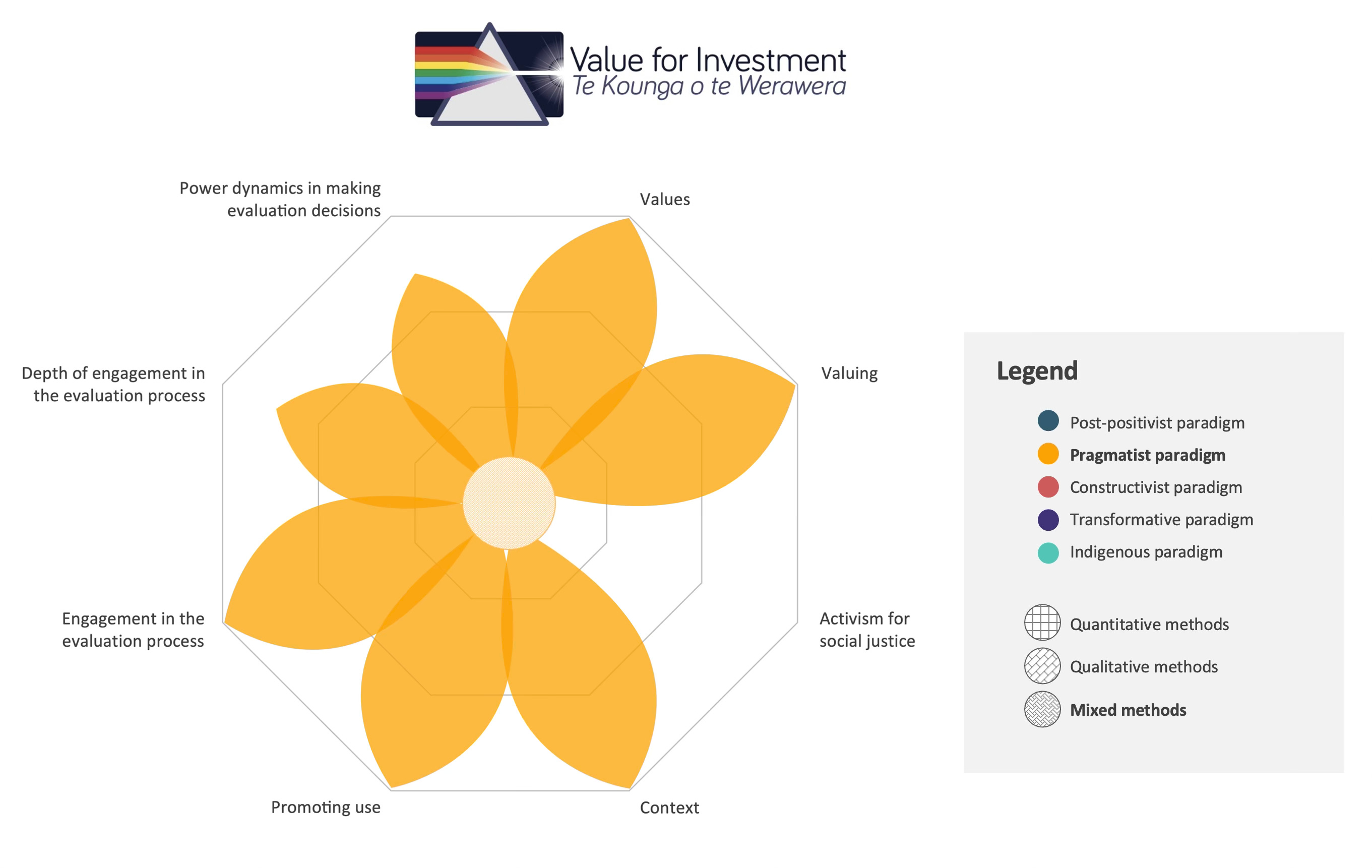
VfI is explicitly a mixed methods approach (as symbolised by the pattern at the centre of the flower). However, I struggled to assign it a paradigm (represented by its colour). I was reluctant to constrain VfI to being post-positivist, constructivist, transformative, indigenous, or pragmatist, because it has the capacity to be used in ways that serve more than one of these philosophical orientations.
Could Cubist Evaluation be a transparadigm, or a paradigmatic bricolage? Cubist Evaluation is aimed expressly at disrupting conceptions of rigour in complexity (analogous to the avant garde Cubist art movement’s pushing of artistic boundaries), though it’s by no means unique in its aims. VfI is a little bit Cubist in its aim of disrupting VfM assessment, and through its mixing of disciplines, methods, reasoning, and sharing power with stakeholders. However, evaluative Cubism is an emergent thought experiment and its principal value to date has been in starting conversations and making new connections with like-minded evaluators.
In the end, I assigned VfI to the pragmatist category. VfI is a practical approach, with sound theoretical foundations, to provide clear answers to real-world evaluative questions. It’s a system that provides a balance of structure and flexibility to facilitate the selection and mixing of methods and tools, guided by a set of principles and a process to support contextually responsive evaluation. Also, it looks good in yellow.
Does the flower need any extra petals?
A defining feature of VfI is that it is interdisciplinary, combining theory and practice from evaluation and economics within the fabric of the approach, and incorporating other disciplines according to the evaluation context. The integration of evaluation and economics is so foundational to the approach that I think it represents the root system of the plant and not an extra petal. It would be interesting to explore the metaphorical root systems of other evaluation approaches too, though it might be difficult to avoid the temptation of grafting bits of the theory tree onto the flowers in the garden.
Bottom line
I like the Garden of Evaluation Approaches and I think VfI looks happy growing in its sunny corner. I hope others will plant flowers here too. There’s fertile ground for evaluators to characterise, compare and contrast evaluation approaches and identify opportunities for cross-pollination.
What about cost-benefit analysis and social return on investment?
Stay tuned - I’ll add CBA and SROI to the Garden of Eval in a future post.1
Acknowledgement
Many thanks to two of the landscape architects of the Garden of Evaluation Approaches, Professors Bianca Montrosse-Moorhead and Daniela Schröter, for peer reviewing my draft. I take sole responsibility for any errors or omissions.
“Garden of Eval?” Really? Though I couldn’t resist the title of this post, it’s an empty play on words with no hidden meaning. It’s a struggle to draw any parallels between this excellent journal article on evaluation approaches, the 2021 NZ documentary “The Garden of Evil” about the murder of Sir Peter Blake, or the anachronistic 1954 Western film "Garden of Evil". Perplexity AI observed that each in its own way involves a pioneering journey into a metaphorical "garden" with shared themes of confronting challenges and navigating complexities. Pretty weak but better than I could have done.