
Real-world VfI examples
Showcasing some recent additions to my resources page

There are currently two main gateways into Value for Investment (VfI). One is this Substack. The other is my website - in particular the resources page, where you’ll find practical guidance, academic publications, and a growing collection of case examples.
There will soon be a third: I’ve signed a book contract with Routledge, with the working title of Value for Investment: An Evaluative System for Government, Public Services, and Social Investment. I’ll continue to share updates on the journey to publication.
Today though, I’m sharing some real-world VfI examples that have recently been added to my resources page. Together, these additions say something about where VfI is being adopted and adapted. These public-domain examples are diverse, ranging from humanitarian innovation, through global funds and multi-country gender-based violence prevention work, to radioactive waste, school-centred community hubs, and city-wide arts investment.
At its heart, VfI is about providing better answers to value‑for‑money questions by combining economic and evaluative thinking, with public value at the centre. All of the cases below are recognisably working on that problem, in their own ways.
Humanitarian innovation: backing worthwhile ideas
Guillaume, M., & Izzi, V. (2025). Worthwhile ideas: A Value for Money guide for humanitarian innovation. Elrha, London.
Humanitarian innovation is risky, long‑term, and deeply intangible. Portfolios of small bets, weak signals, uncertain pathways to impact, and strong ethical obligations all mean the usual cost‑per‑output routine doesn’t get you very far.
Elrha’s guide to value for money in humanitarian innovation is a rich example of VfI principles adapted for a new domain. Elrha is a UK‑based charity that funds and supports humanitarian research and innovation, sitting in the space between big global funders and frontline responders. They work across multiple crises and sectors, backing ideas that could improve how the humanitarian system serves people in extremely tough circumstances.
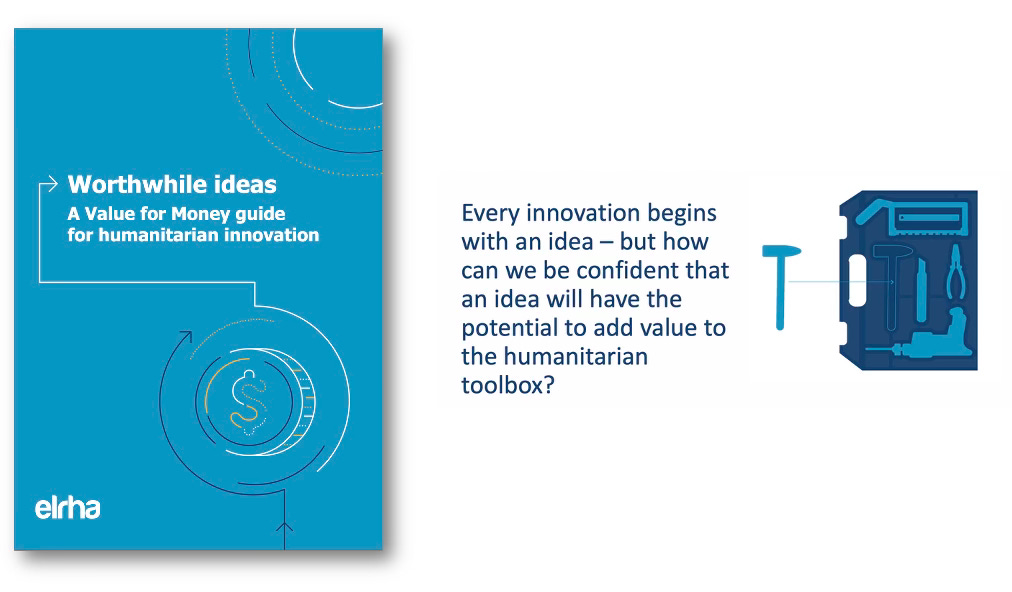
VfM is tricky in humanitarian innovation for many reasons, including:
Resource scarcity. Needs are rising faster than budgets, and trade‑offs are stark; VfM is always in the shadow of finite or shrinking resources and very high stakes.
High uncertainty. Contexts are fluid, evidence is imperfect, and not every promising idea will land.
The innovation paradox. There is tension between urgency (people need help now) and experimentation (we need to try new things), with the risk that costly failures may be borne by people in crisis, even as “failed” ideas can be valuable as learning for the system.
Power and accountability. Decisions about what to test and scale are often made far from the communities affected; who gets to decide what counts as “value” is not a neutral question.
The ethical imperative. In this context, VfM is not just an economic question; it is directly about ethical responsibilities toward people in crisis.
Elrha’s framework is explicit about this. It frames VfM assessment as a tool to support decision‑making (not as the decision‑maker), and explicitly situates VfM alongside other decision considerations in high-stakes settings.
This framework is about making good choices when supporting innovation. Elrha starts by asking what good value looks like for humanitarian innovation portfolios: supporting learning, surfacing and pruning lower-value ideas early, and scaling promising ones. Value for money, in their hands, is something that should help innovation teams feel supported rather than policed. Ethics and do‑no‑harm are bottom lines, not trade‑offs.
This guide does not lean on monetisation as the primary way to judge value, and instead prioritises structured, evidence-informed judgements about costs, benefits, learning, and risk. The guide is clear that the job is to produce a transparent, reasoned judgement, grounded in evidence and argument, not an illusion of precision.
Elrha’s framework models core VfI principles, from starting with a clear value proposition, to using multiple kinds of evidence, and ending with a transparent, deliberative judgement, assisted by explicit criteria and standards. If anybody’s mental model of VfM is still “cost‑benefit analysis plus some hand‑waving about intangibles”, Elrha’s work is a really helpful counter-example.
Global scale and contested terrain: the Spotlight Initiative
Carou Jones, V., Tywuschik-Sohlstrom, V., Chua, N. (2024). Value for Money Assessment of the Spotlight Initiative. October 2024. SWEO/2024/001. United Nations Sustainable Development Group System-Wide Evaluation Office, New York.
The Spotlight Initiative is a multi‑year, multi‑country programme focused on ending violence against women and girls - involving multiple UN agencies, country variations, and a theory of change that runs from services to laws to social norms.
In this value for money assessment, we see recognisable VfI features. The assessment uses four criteria - economy, efficiency, effectiveness, and equity - to frame 20 areas of inquiry. Judgements are made using explicit performance standards (based on OPM’s guide) to differentiate excellent, good, adequate, and poor performance, and a performance language anchored in a complex theory of change on gender-based violence (GBV) prevention, response, and norms change. The criteria and sub-criteria go well beyond counting activities, and cover issues such as implementation quality, adaptability and responsiveness, innovation and piloting new approaches, learning and knowledge management, catalytic effects/leverage, and the integration of human‑rights and gender‑equality approaches in design and implementation.
In a programme like Spotlight, it would not be very meaningful to assess VfM based on ratios like “cost per case of violence averted”. The assessment is informed by mixed methods including case studies, survey data, interviews, planning and monitoring data, accompanied by a realistic treatment of the limits of outcome data across dozens of contexts. Costs still matter, but they are held up against a rich picture of change and value, not a single scalar outcome.
Spotlight is working in contested political terrain, across multiple countries and systems. In these diverse settings, their VfM framework shows how much further you can get by moving beyond cost‑per‑X ratios towards an explicit evaluative framework that supports transparent and traceable value judgements.
Multi-lens portfolio assessment: the Global Challenges Research Fund
Barnett, C., Vogel, I., Hepworth, C., Guthrie, S., Coringrato, E., Puri, I., Wade, I., Rodriguez Rincon, D. (2025). Value for Money Assessment: Global Challenges Research Fund. Research Paper Number DSIT 2025/010. Department for Science, Innovation & Technology, London.
The Global Challenges Research Fund (GCRF) VfM assessment applies evaluative reasoning and mixed methods in a large research funding context.
The GCRF is a £1.5 billion UK government funding stream that, over several years, channelled resources into research partnerships between UK institutions and low‑ and middle‑income countries. The aim was to support excellent research that also contributed to the Sustainable Development Goals, with a strong emphasis on equitable partnerships and Southern leadership. Once the initial waves of funding were committed and many projects were underway, the Department for Science, Innovation & Technology (DSIT) commissioned an independent VfM assessment to take stock at portfolio level and to ask how well the fund’s actual investments and practices lined up with its stated public‑value ambitions.
The VfM assessment of the GCRF features multiple lenses on value. The evaluation team developed a rubric‑based approach using an adapted 4Es framework with 14 sub-dimensions. Under effectiveness, for example, they looked at research quality and use, sustainable and equitable partnerships, enhanced challenge‑oriented capabilities, and pathways to impact. Equity was treated as a cross-cutting criterion, looking at who benefits, who leads, and how far the work aligns with the fund’s public‑value aims. For this sample, the cost-effectiveness dimension could not be assessed because of data limitations.
The assessment is explicitly portfolio‑level. It asks, across diverse awards – large research centres, networks, fellowships, applied projects – whether the portfolio looks like a good way of delivering on the GCRF value proposition. That is a much better fit for complex and diverse research funds than attempting to meaningfully rank every grant on a common marginal cost‑effectiveness yardstick.
VfI goes underground: the Geological Disposal Facility
Verian and Oxford Global Projects. (2025). Geological Disposal Facility Evaluation Plan. Evaluation Task Force (UK).
Radioactive waste is not the most obvious place to look for thoughtful VfM work - but the UK’s Geological Disposal Facility (GDF) programme is a strong exception.
The evaluation plan is explicit about uncertainty and public value. It starts by acknowledging “known unknowns”, overlapping phases, difficulty finding counterfactuals, and very long timeframes. It structures the evaluation in three mutually‑informing strands – implementation/process, impact and VfM – with contribution analysis and quasi‑experimental comparisons in the mix, plus simulation to update business‑case assumptions as evidence evolves. It explicitly recommends a Value for Investment approach, alongside Green Book and National Audit Office (NAO) guidance, because it provides a framework where both monetised and non-monetised benefits contribute to explicit evaluative judgements.
Three features are worth highlighting:
Phased, adaptive evaluation: The plan lays out different evaluation questions and methods for different phases: early community engagement and consent processes; site characterisation and the Test of Public Support; design and construction; initial operation; and, much later, closure. At each point, it asks “what can we really observe and judge now?” and treats the business case as a living hypothesis to be updated.
Contribution, not attribution: Impact work is framed in contribution terms, combining multiple lines of quantitative and qualitative evidence (community indicators, institutional changes, perceptions, economic modelling), with an explicit acceptance that attribution will always be partial. That is a healthy stance in any complex programme; it is essential in one that will run for decades and interact with countless other influences.
Bringing VfI into the Green Book world: The Green Book provides the UK government’s core guidance on appraisal and cost-benefit analysis, and is clear that VfM is ultimately a balanced judgement that must weigh wider (including non‑monetised) considerations alongside benefit–cost metrics. The GDF team proposed VfI because the plan notes that important parts of the value proposition – such as community consent, trust, intergenerational equity, and environmental safeguards named in the business case and programme documentation – could not plausibly be reduced to monetised flows. VfI here is a way of integrating those dimensions with cost and risk information, in a coherent, transparent judgement over time.
When the people responsible for burying radioactive waste are grappling explicitly with uncertainty, public value and structured judgement, it tells you something about where the mainstream is moving regarding evaluating in complexity.
Place‑based public value: schools as community hubs
Aston, R., Clinton, J. M., & Paproth, H. (2023). Are schools as community hubs worth it? In B. Cleveland, S. Backhouse, P. Chandler, I. McShane, & J. M. Clinton (Eds.), Schools as community hubs: Building “more than a school” for community benefit (pp. 323–334). Springer.
VfI is not just for global funds and big infrastructure - it’s equally at home in local place‑based work. Two chapters from the book, Schools as Community Hubs, are a neat illustration.
In “An Evaluation Framework for Schools as Community Hubs”, Janet Clinton, Ruth Aston and Hayley Paproth adapted the CDC evaluation framework to the realities of hubs. They emphasised engaging stakeholders, making the theory of change explicit, focusing the evaluation on the right questions, and using mixed qualitative and quantitative evidence against clear criteria and standards, with equity and contribution built in.
In “Are Schools as Community Hubs Worth It?”, Aston, Clinton and Paproth took on the “is it worth it?” question directly. They walked through the familiar economic tools – cost‑benefit analysis, cost‑effectiveness, cost‑utility, cost‑consequence, social return on investment – and argued why, on their own, each is too blunt for complex, multi‑goal, place‑based work. They concluded by arguing for a Value for Investment approach with an explicit equity lens, using rubrics to define performance levels, and bringing multiple sources of evidence into a transparent value judgement.
Schools as community hubs are, by design, trying to address “wicked problems” – clustered disadvantage, fragmented services, weak social capital – using the universal platform of a local school. They typically involve multiple funders, multiple partners, and layered ambitions (learning, health, wellbeing, community connections). In that setting, I would contend that:
Single benefit–cost ratios tend to obscure more than they reveal.
Equity isn’t peripheral to VfM; it is core to the definition of success.
Contribution stories, backed by numbers where they’re meaningful, are a powerful way to make sense of change.
VfI is a natural fit.
City-level public value: arts investment in Tāmaki Makaurau
Field, A., Hunter, A., Parslow, G., Ruka, C. (2025). Arts Matter evaluation report. Report for Auckland Council. Dovetail Consulting, Auckland.
Closer to my home, Auckland Council’s Arts Matter evaluation shows what VfI can look like in city‑level arts and culture investments. The evaluation uses six case studies of council arts investment in different initiatives and venues to explore the types of value generated, and what this implies for future council investment and support.
The evaluators worked within a VfI frame: they examined whether Auckland Council’s arts and culture investments are a good use of public resources to generate social, cultural, and economic outcomes for Aucklanders, and how more value could be created. The cases span forms of support beyond funding alone, including staff resourcing, venue provision and subsidisation, and capacity-building, and they show how these elements combine to create public value.
Rubrics were developed with stakeholders to describe what “good” looks like for different dimensions of value:
Stewardship of resources
Building artistic, social and cultural capital
Generating social and economic value.
Multiple forms of evidence, from interviews, focus groups, survey, document review, and observation, were brought together and weighed against the rubrics to reach explicit evaluative judgements about performance and opportunity. Economic evaluation methods were not used, but the evaluation qualitatively examined the role of the cases in fostering economic activity.
Framed this way, VfI at city scale is about how a mix of resources, relationships, and culturally responsive approaches work together to generate cultural and social value, and economic potential, across Tāmaki Makaurau. The Arts matter evaluation shows how local government can apply evaluative thinking about scarce resources, through the use of rubrics and participatory sense-making, in a way that fits the complexity and diversity of a metropolitan arts ecosystem.
Threads that run through these examples
Across humanitarian innovation, global GBV work, research funds, radioactive waste, school‑centred hubs, and city-level arts investment, a few common threads emerge:
From projects to portfolios and systems: None of these examples is really about isolated projects. They span portfolios (Elrha, GCRF, Spotlight), systems (school hubs, city arts ecosystems), or whole lifecycles (GDF). They showcase applications of VfI as a portfolio and system framework.
Explicit evaluative judgements: All of them are moving away from the idea that a single number can bear the weight of judgement. Instead, they are using rubrics and mixed methods to guide deliberations and reach structured, defensible judgements that make values, evidence and reasoning visible.
From “neutral” technocracy to public value: Rights, gender equality, equitable partnerships, Southern leadership, community consent, intergenerational equity, and place‑based wellbeing take centre stage – they’re not being treated as “soft” add‑ons. They are prominent in the criteria. That is what a public‑value lens looks like in practice. Value for money is more than efficiency alone.
From one‑off assessments to ongoing sense‑making: There’s a shift from “doing a big evaluation at the end” to phased, repeated assessments and continuous learning: Elrha’s emphasis on portfolio learning; Spotlight’s iterative cycles; GDF’s planned VfM assessments at multiple milestones; the hub frameworks’ focus on feedback loops.
All of this is recognisably VfI‑shaped. Hats off to the teams who undertook these projects, building in VfI principles and processes alongside other frameworks and tools to develop contextualised, fit-for-purpose evaluations in diverse settings.
If you have an example to add, drop me a line
If you’d like to explore these reports and more, my VfI resources page pulls together guidance, case examples and tools. I’m keen to keep the page up to date and as useful as possible, so if you have a publicly available example you’d be happy to share, I’d very much like to hear from you.