

Value for money (VfM) is sometimes assumed to be synonymous with cost-benefit analysis (CBA) - but VfM and CBA are not the same, and conflating them hinders our potential to make good resource allocation decisions. Value for money (good resource use) is something we can evaluate using various methods, including but not limited to CBA.
For decades, CBA has been the go-to tool for evaluating the economic viability of policies, programs, and projects. By quantifying and comparing costs against benefits, measured in monetary units, CBA provides a systematic, rational way to assess whether something creates more value than it consumes.
CBA brings a unique perspective and I advocate that we should use it more in evaluation, but even the best CBAs may only get us partway toward a comprehensive assessment of VfM. For example, many initiatives have objectives and impacts that are hard to value monetarily or that extend beyond economic efficiency. In such cases, relying solely on CBA can lead to an incomplete or distorted understanding of value.
Here are two diagrams that highlight the challenge, and two that outline a solution enabling rigorous assessment in contexts where economic methods are challenging to apply or insufficient to comprehensively evaluate program resources, processes, consequences, and value.
The concentric ellipses of monetary valuation
In CBA, the values of costs and benefits are measured in monetary units ($, £, €, or your currency of choice). These monetary valuations are key inputs in a CBA.
A range of options exist for estimating monetary values of things. Sometimes, the values of interest are financial and that’s convenient because they’re already measured in money. However, social CBA also uses money as a unit of measurement for non-financial value. So, where do those figures come from?
The value of some things can be revealed by observing prices set by well-functioning markets. In other cases, we can set up pretend markets or valuing games in which people reveal, through choices and trade-offs, what they would be willing to pay for a benefit. Or we can simply ask them - e.g., by conducting a survey. In some cases, we can reference an estimate that someone else has already produced, from literature or a values bank (like this one).
As we shift from measuring monetary values to estimating them (moving from left to right in the following diagram), our valuations become more uncertain.
There’s a trade-off between the kind of accuracy, precision and reliability1 we expect from a set of audited financial accounts, for example, and the comprehensiveness2 of a social CBA that includes significant intangible benefits. As the scope of benefits and costs becomes more comprehensive, our estimates may become less accurate, precise and reliable.
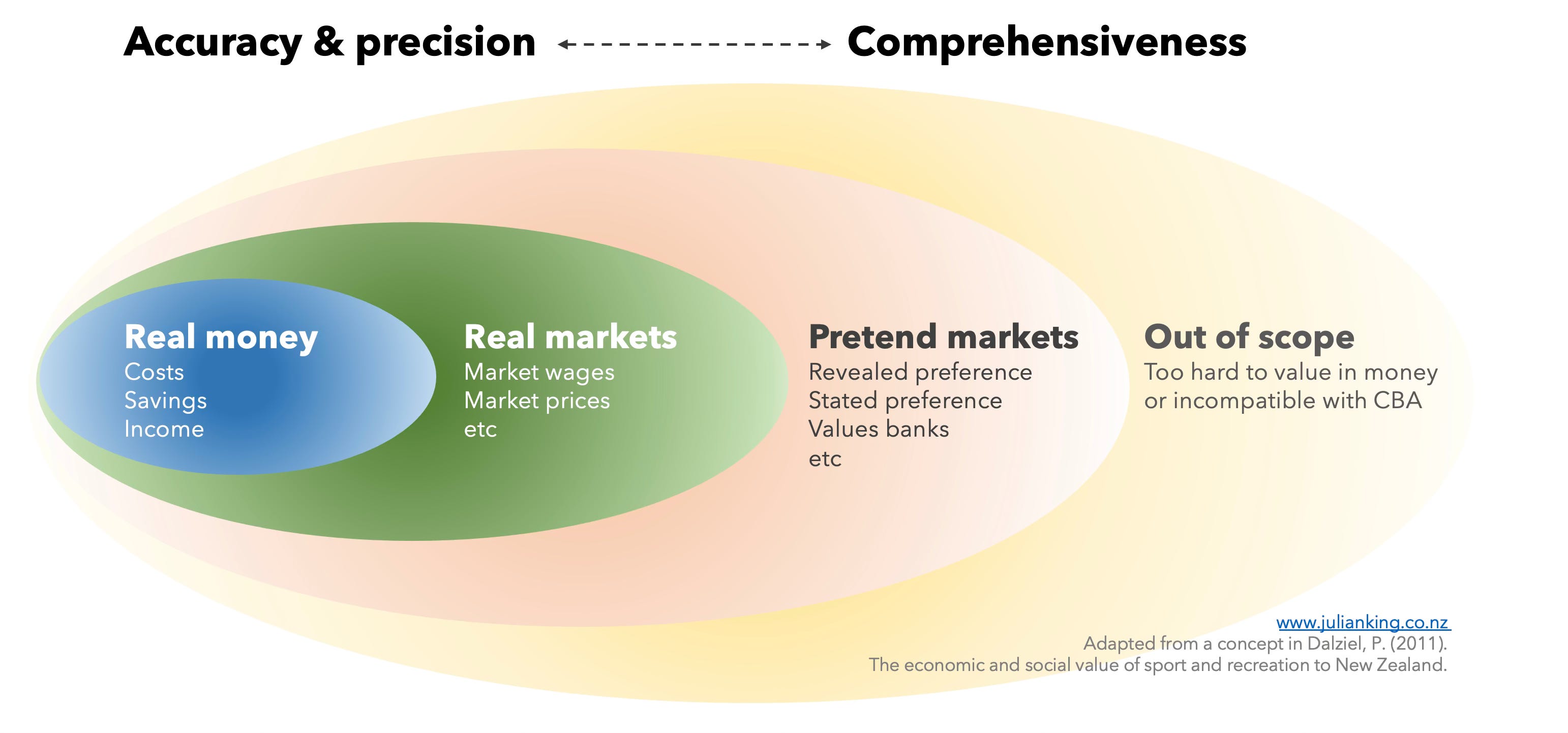
Moreover, some values may turn out to be just too hard to value in money (e.g., what’s the monetary value of an increased sense of hope?) or may not fit with with the efficiency focus of a CBA (e.g., the relevance or ethicality of an investment, or the value of a redistribution of resources). Some aspects may therefore, in practical terms, be outside the scope of monetary valuation.
The precision / comprehensiveness / credibility trilemma of net present value
Net present value (NPV) is a key indicator that comes out of a CBA. It is calculated by taking the sum of all benefits minus the sum of all costs, adjusted for timing. If NPV is greater than zero, it indicates that the policy, program or project creates more value than it consumes (benefits exceed costs) and can be deemed worthwhile.
To estimate the NPV of a social program it is desirable to include as many social benefits and costs as possible, but as the previous diagram illustrated, some are hard to credibly value in monetary terms. When it comes to estimating and reporting the NPV, we may face a triple trade-off between comprehensiveness, precision, and credibility.3
For example, in order to present results that are precise and credible, we may need to limit the scope of our study to a narrow set of costs and benefits, sacrificing a degree of comprehensiveness. On the other hand, we could design a study that is more comprehensive and, to ensure its credibility, conduct sensitivity analysis that reveals a range of possible results - sacrificing some precision. Either way, we must avoid eroding credibility by presenting comprehensive results with false precision.
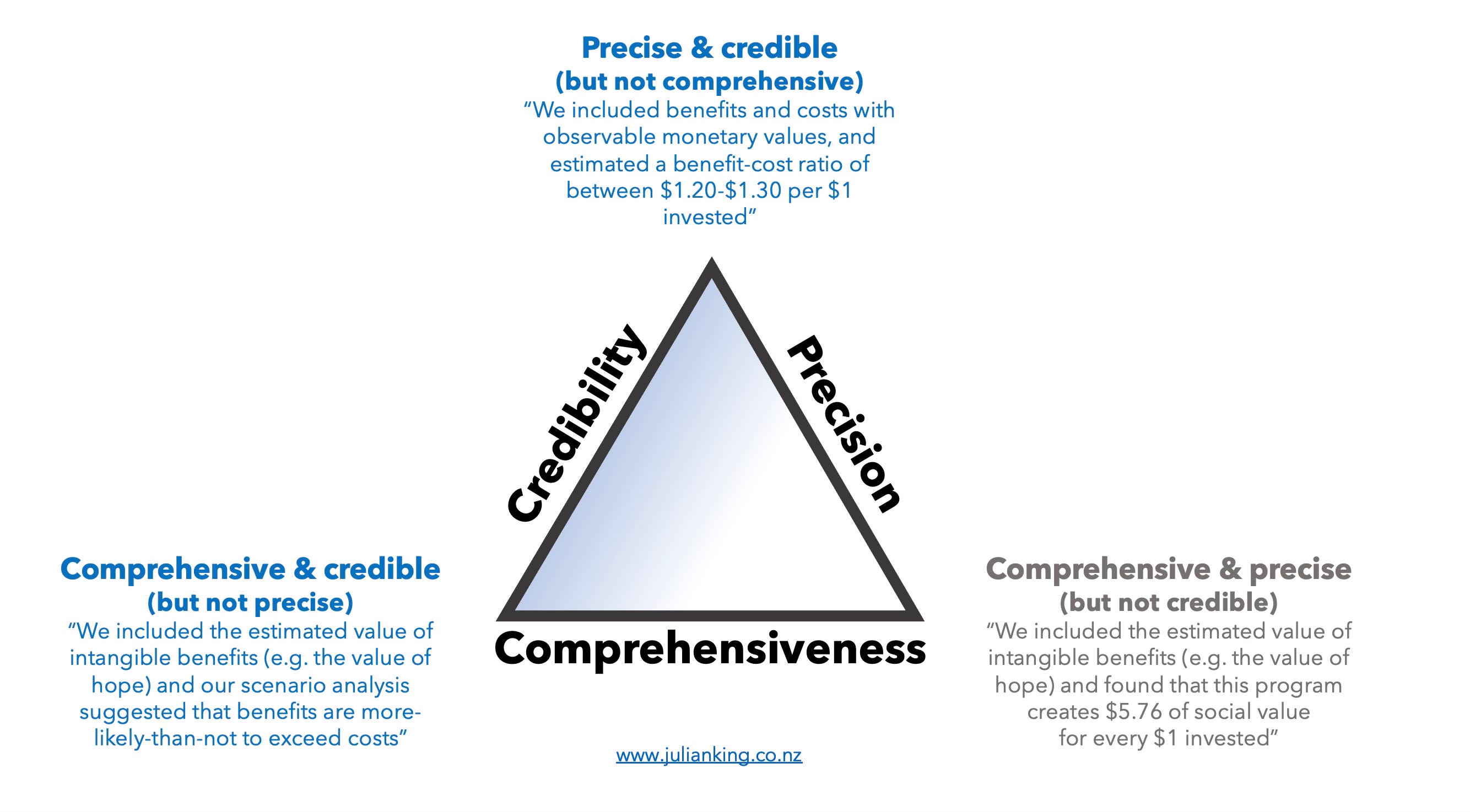
We can put monetary values on some intangible benefits but we have to decide how much uncertainty we’re willing to accept. In our efforts to achieve a reasonable balance of comprehensiveness, precision, and credibility, we may decide to leave some intangible values out of the analysis, even though they could in principle be given monetary valuations. We can still mention them in the write-up. But ultimately they are left out of the NPV calculation - and that’s OK. Monetary valuation is a choice, not a requirement.
What’s more, we don’t have to consign intangible values to the discussion section or a footnote. The field of program evaluation has methods and tools to help us synthesise monetary and non-monetary values.
The prism of evaluative clarity
There are various metaphors for evaluation. Mine is a prism. The prism represents a set of explicit values (which can be set out in a rubric), co-developed with people whose lives are affected and those with other stakes in the investment, which we can use to synthesise a broad spectrum of mixed methods evidence (qualitative, quantitative, and economic), producing a lucid beam of evaluative clarity.
This approach answers the call from some economists and other public policy experts to integrate insights from CBA with wider considerations to inform decision-making. This way, we can accommodate the best intel from CBA without limiting ourselves to economic methods and metrics alone.

This approach enables us to:
Take a wider view of resources, actions, impacts and value than CBA can do on its own.
Provide a more comprehensive evaluation where CBA is insufficient (e.g., where it only includes some of the value, missing important non-monetary or non-efficiency aspects).
Conduct CBAs that ‘stick to their knitting’, contributing a sound estimate of NPV based on monetisable factors without stretching the limits of credibility by attempting to include the hardest-to-measure intangible values.
Assess VfM in circumstances where CBA isn’t feasible.
On the last point, I’ve just added a new example to my resources page. Check it out:
Field, A., King, J., Moss, M., Parslow, G., Schiff, A., Chianca, T.K., Chianca, G., Mattiello, C. (2024). Urban 95/Ateliê Navio Value for Investment evaluation. Report for Van Leer Foundation. Dovetail Consulting Limited, Auckland.
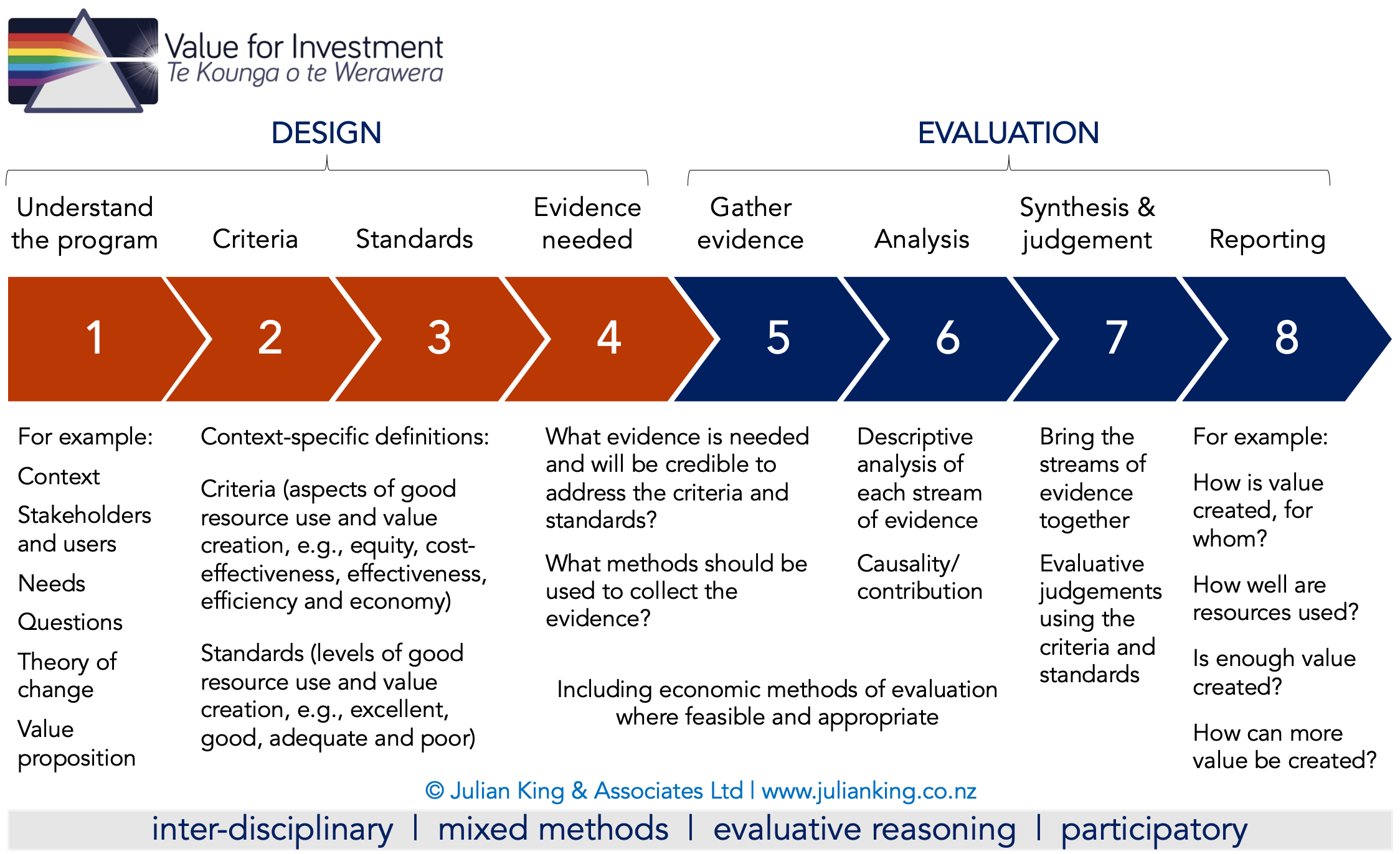
The 8 steps of Value for Investment
This is the how. You may have seen this diagram before, but I’m including it here for new readers. This approach is designed to provide sound answers to VfM questions through rigorous evaluation. As this article explains, the approach is interdisciplinary (combining theory and practice from evaluation and economics). It uses evaluative reasoning and mixed methods (like the prism), and it’s participatory, sharing power and involving stakeholders in evaluation design and making sense of evidence. Practical guidance is available in this free guide I co-authored with Oxford Policy Management, this one with Dovetail Consulting, on my website, and right here on Substack. Using this approach, we can capitalise on insights from CBA and other evaluation methods, using evidence and explicit values to inform good decisions.
Thanks for reading!
If you like this article, please hit the ❤️ button to increase its visibility on Substack.
In the context of a CBA, when I refer to accuracy, I mean how close the estimated costs and benefits are to their true values. An accurate CBA should minimise errors and biases in data collection, assumptions, and calculations to provide results that closely reflect reality. When I refer to precision, I mean the level of detail and specificity in the CBA estimates, which should be appropriate to the uncertainties involved. For example, are we valuing something at $276.35, or around $250-$300? When I refer to reliability, I mean the consistency and reproducibility of the CBA results. Reliable estimates of costs and benefits should yield similar results when repeated under the same conditions, using the same data and methods. We could also talk about validity, the extent to which the estimates meaningfully represent the costs and benefits they’re intended to measure.
When I refer to comprehensiveness, I mean the scope of costs and benefits included in the analysis. Are we trying to include a monetary value for every conceivable cost and benefit, or are we limiting the analysis to values that are material and feasible to estimate to a reasonable degree of accuracy, precision, and reliability? I contend that the greater the scope of intangible benefits included and monetised in a CBA, the greater the compromises we may have to accept in accuracy, precision and reliability. The right compromise is a matter for analyst judgement.
When I refer to credibility, I mean the degree of confidence and trust that stakeholders and decision-makers can place in the CBA results. Credibility is related to accuracy, precision and reliability, as well as how closely the conduct of the CBA followed established guidelines and good practices, the experience and qualifications of the analysts, how transparently the assumptions and data are presented, and the manner in which the results are reported and discussed including uncertainties and limitations. I contend that: a) sensitivity analysis enhances credibility by testing the robustness of results to changes in key variables; and b) reporting findings to an appropriate degree of precision, with range estimates and break-even analysis, enhances credibility by shedding light on the implications of uncertainty in the analysis.
Great article Julian, it definitely makes one appreciate the trade-offs between comprehensiveness and accuracy. Also, wholeheartedly agree that CBA should be one tool of many that combine to form evaluative judgements. Although not specifically referenced in your article, I wanted to ask about the role of sensitivity analysis and statistical analysis in CBAs. Would advances in CBA methodologies (particularly with things like Monte Carlo analysis) help us appreciate the uncertainties, means, SDs etc. in NPV under different scenarios? Is this actually a thing that's happening that at least allows us to do social CBAs with a greater understanding of our accuracy trade-off? Thanks :)